Your Questions,answeredAnswered
-
Flex industrial space is a type of commercial real estate that allows businesses to use their space according to their changing needs. According to an article on MyEListing, flex industrial space is typically leased on a short-term basis with a variety of amenities and features that may include loading docks, conference rooms, kitchenettes and parking.
Many flex industrial spaces are strategically positioned near urban centers and major highways to ensure easy access for employees, suppliers and customers. According to an article in Allied Buildings, the amount of space occupied by distribution centers and warehouses has increased by 86.2% in the last 23 years. The high demand has led to rapidly rising costs for industrial space, making it more difficult for small businesses to buy or lease traditional warehouses. Flex space allows businesses to create a central location that combines office space with storage space.
-
Flex spaces are often less expensive than traditional industrial space, and they combine office space, warehouse, and industrial space in one building, typically one-story so it’s easier to access. These characteristics make flex spaces optimal choices for small businesses. Flex spaces come in a variety of sizes, so it can be easy for a business to expand or downsize as needed. There are no extra areas like large lobbies or hallways, so the business pays for the exact amount of space they need.
Most spaces come with electricity and heat, and they are adaptable to fit the business’ specific needs. The versatility allows businesses to combine office, retail, and warehouse space in a single unit, which eliminates the need for multiple leases, which ultimately reduces overall operational costs. Shorter leases allow businesses to customize the length of their rental period.
-
Because flex buildings are often rented to multiple tenants, there may be more noise penetration from other businesses. Flex spaces are not always climate controlled (air conditioned). While businesses generally have space to expand, there may be limitations to the extent of expansion within a property. Relocating can be costly and disruptive if the business outgrows a space.
Local zoning regulations may prohibit certain types of businesses from using the flex industrial spaces which would limit options for potential tenants. The combined amenities may require higher maintenance expenses. The flex space may convey a more industrial or utilitarian feel which may limit a business’ opportunity to establish a strong corporate image or branding.
-
Business & Industrial Uses
Light Industrial / Trades
Contractors (HVAC, electrical, plumbing, roofing)
Fabrication shops (light metal, woodworking, prototyping)
Specialty installers (flooring, windows, solar)
Equipment storage and staging
Logistics & Operations
Last‑mile delivery hubs
Small distribution or fulfillment centers
Inventory overflow for e‑commerce
Packaging and kitting operations
Automotive & Mechanical
Auto detailing or ceramic coating
Small repair shops (non‑hazardous)
Motorcycle/ATV repair
Fleet storage and maintenance
Retail & Customer-Facing Uses
Showrooms for furniture, cabinets, flooring, or appliances
Boutique retail with back‑of‑house storage
Specialty shops (bike shops, outdoor gear, hobby stores)
Seasonal retail operations
Professional & Creative Uses
Hybrid office + warehouse for small businesses
Photography or videography studios
Architecture, design, or engineering firms needing shop space
Maker spaces or creative workshops
Art studios with storage for materials
Storage & Personal Uses
RV, boat, or classic car storage (if ceiling height allows)
Personal workshop or hobby garage
Climate‑controlled storage for valuables or collections
Document or equipment archives
Specialized Uses
Small labs (non‑hazardous)
Tech repair or electronics assembly
3D printing and prototyping
Specialty food production (dry goods, packaging, no grease traps)
Lifestyle & Community Uses
Fitness studios (cross‑training, martial arts, yoga)
Indoor training facilities (golf simulators, batting cages)
Community workshop or club space
Podcast or content creation studios
Startup & Entrepreneurial Uses
E‑commerce startups needing fulfillment + office
Subscription box companies
Local brands scaling production
Small manufacturing (apparel, signage, custom goods)
-
Our facilities offer a unique mix of high-end and intermediate units, as well as utilitarian options for the budget-conscious small business and boat/RV owners in need of storage. The three types are thoughtfully designed with amenities and upgrades to command the highest rental rates and bring strong return on investment.
The REFLEX facilities also create a sense of community rarely seen at flex warehouse properties. By cultivating a serene, park-inspired setting with generous landscaping and green areas along the buildings' shorter sides. The longer sides feature bioswales and rain chains, complemented by seating zones. Rain chains are more visually appealing than gutters and eliminate the need for irrigation.
-
Flex space can be a strong investment because these spaces are more easily leased, don’t require much renovation and are in high demand. Flex spaces see the highest rental rates of all types of industrial real estate. More and more businesses are seeking flexible spaces that can be adapted easily in order to accommodate their changing storage and distribution needs, especially with the growth of e-commerce.
Flex industrial space is a distinct asset class that can be used to diversify an investor’s portfolio. With the versatility of the flex spaces, investors can renovate them when necessary, increasing the space’s value and potential for appreciation. Furthermore, flex spaces provide long-term stability because demand for them remains relatively stable even during economic downturns.
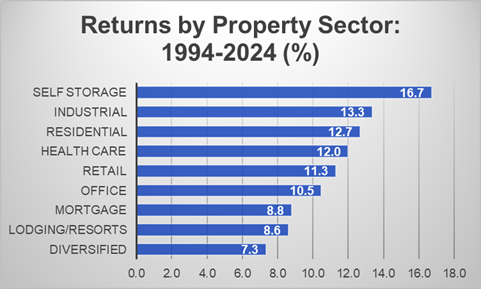
Industrial property is one of the fastest-growing sectors of the U.S. commercial real estate industry, according to NAREIT. As shown in the chart below, returns for industrial real estate are second only to self storage.